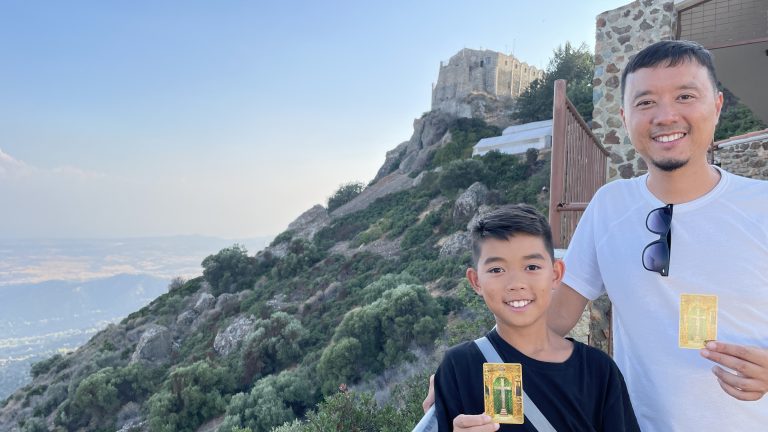
In 2022, I took a pilgrimage to some of the most significant places of Christianity – Turkey, Lebanon, Greece, Cyprus, and Rome. And the most transformative experience was my visit to the Stravourouni Monastery in Cyprus. It was an hour-long encounter with an Orthodox monk named Macarios that changed my perspective on the Eastern Church and led me on a journey to the Orthodox faith.
In my late 20s and early 30s, I was exposed to some Orthodox theology while a student in a Protestant seminary. I remembered studying about the early church in the Patristic Theology class. Learning about the early church was something very foreign to a Protestant. A Protestant can know quite a bit about the Reformation, and the various theological schools since the 16th century. But the theology of the early church was not taught in Sunday School nor in a typical Sunday sermon.
I was really fascinated by the Orthodoxy way of describing the main purpose of human history. God wanted humankind to become like him. In St Athanasius’ words, “God became man so men can become god.” Christ’s incarnation achieved for us not only the salvation of our souls, but the deification (theosis in Greek) of the entire person. We achieve by grace what God is by nature. I learned that for the first thousand years, the Church’s de facto understanding of Christ’s salvific work was Jesus as the Christus Victor, Christ the Conqueror, in contrast to the legal framework developed in the Medieval time by St Anselm’s theory of satisfaction which undergirded the Catholic and Protestant soteriology. Everything I read was so foreign, yet it made so much sense even at that time.
Fast forward to twelve years later in 2018. I have served for 7 years as a pastor at a Protestant Church. I became an Anglican in 2019 and loved the Book of Common Prayer and the Anglican liturgy. I had a spiritual director who was a retired Catholic priest, and read and studied the Catholic teachings for a while. I was quite comfortable with Vatican II and enjoyed participating in the modernized Catholic Mass. So what was the key factors that led to my decision to become an Orthodox Christian?
There are at least three ingredients: relationships, worship, and history.
Friendships
The main obstacle that prevents non-Orthodox from getting to know the faith is a lack of relationship with an Orthodox believer. In hindsight, learning about the early church history, knowing about the key concepts of Orthodox theology, even having visited Orthodox churches were not enough to tip the scale when it comes to embracing the Orthodox faith. It requires knowing an Orthodox believer. In God’s perfect timing, he brought Orthodox friends into my life. My first visit to the Middle East in 2020 was an important milestone in my journey. I became very close friends with two young men who grew up in the Orthodox Church (who both became Arab Evangelicals in their teenage years. Note that the Arab Evangelical movement is very different from what one thinks of as American Evangelicalism). And through these two brothers, the Orthodox faith and its effects became tangible to me. I learned of how the Orthodox faith has penetrated into every fabric of the Syrian Christian society, as how it is still a lived reality to many in the Middle East. A modern Orthodox person would still lament of the trauma of the Muslim conquest of the Christian Byzantine Empire (since the 7th century AD) and the attrition of the Christian Church and culture as a result of the Ottoman occupation (since the 15th century).
I am privileged to get to encounter the Orthodox faith as lived reality through these two precious brothers in Christ.
Worship
My theology of worship went through a drastic change since 2018. Having participated and led worship in a predominately “low church” setting until the age 37, I realized I was yearning for something more in 2018. I took a Sabbatical in that year, after having served as an Evangelical pastor for 7 years, and my family spent three weeks in Italy.
Having studied about the European cathedrals in seminary, standing inside them was a very impactful experience. From the Duomo in Milan to the humble chapel of San Damiano outside of the city of Assisi, I experienced the historic European churches for the first time in my life. Inspired by the example of radical obedience of St Francis of Assisi, I took a radical step of my own – to resign from my role as a pastor at my church, a decision made during my Sabbatical trip. It was not a simple or an easy decision, but God provided the impetus to enable me to make that important decision, which had tremendous implications for my journey to Orthodoxy, as it eventually shown.
Just how difficult is it to go through a religious conversion of this sort? Of course, it was not just a simple decision. It was a long process. But it is important to recount to the best of my ability the contour of that journey. I would venture to argue that it is exponentially unlikely that this type of conversion happened in a clergy due to the fact that it does not just involve a change of belief or a lifestyle or a faith community, but it involves the giving up of one’s training and career as a credential clergy. It is like for an accountant to convert to being an engineer, or for a laywer to convert to being a doctor. Of course it is very difficult. But by God’s grace, even the most unlikely becomes a reality. Though it was a huge leap of faith, a small step needs to be taken first. And it was a step toward Anglicanism.
In hindsight, my conversion to Anglicanism was a really important step toward my eventual conversion to the Orthodoxy. I visited a new church every Sunday for 6 months – two black churches, an Eritrean Orthodox Church, several Catholic parishes, several charismatic churches, and some small, evangelical church plants. I had a heart for small churches, and thought at the time that God was leading me to a small church plant where I would serve and would call home. I knew I found my new spiritual home when I visited St John’s Anglican Church. I was deeply impressed by the simplicity and spirituality of the Anglican worship.
Of the three years I worshipped at St John’s, God taught me many things about worship through its humble leaders and parishioners. It affirmed my take-away in Assisi – God used simple, humble people for his divine purposes. God certainly used St John’s Anglican Church to help me mature. God also convicted me of the spiritual pride of American Christianity. I began to learn to serve humbly, and to submit myself to one another, to the liturgical tradition, and to the historic Church through its bishops. I led two important projects in the church, one is to fundraise for an African bishop who was finishing his D. Min study in the US, and the other one is to lead the church through a process called Appreciative Inquiry. When both were completed, I felt released from the call and was ready to embrace a new call from God. So comes the summer of 2022 and the trip to the Middle East.
History
Our 5-week Middle East trip begins at Istanbul, where the Byzantine Empire had its capital in what was name Constantinople for almost a thousand years. I personally was deeply impacted by seeing Hagia Sophia and the Cave Churches in Cappadocia. St John Chrysostom and his ministry in Constantinople, St Basil the Great and his monastic communities in Cappadocia, the importance of the Cappadocian Fathers in the Christological Debate and their theological contributions, all came alive in our three weeks in Turkey. Among the ancient Roman cities, it still gives me goose bumps when I think of standing near the site of Polycarp’s martyrdom in Smyrna (modern day Izmir) and the riots Paul caused with his preaching of the gospel in ancient Ephesus.
But what is the importance of church history? Aren’t these just events in the past that have no implication to the present context? Aren’t these topics only important to the bookworms and history-lovers? The answer is ‘no’. I believe that they are important for all Christians. In fact, the Orthodox Way emerges as all the more convincing when one begins to study church history.
The main idea of the book, What is Orthodoxy by Peter A. Botsis, which was given to me by the monk Macarios, is as follow: the Catholic Church departed from the Orthodox faith in her doctrines of the filioque, the papal infallibility, and the immaculate conception of Mary, and hence it is incompatible with the apostolic faith as it was handed down by the apostles and needs to repent of its doctrinal errors and be reconciled with the One True Church. As an Anglican who has high hope of ecumenism with the Catholic Church, this book really opened my eyes to the challenge of ecumenism. The premise of the book is correct – there can be no unity without orthodoxy. Unity is not achieved by merely respecting each other’s respective traditions (which is based on some form of relativism), but requires a sincere pursuit of truth. I found this a more honest approach when dealing with differences. It requires confronting doctrinal errors, and genuine repentance of those errors (i.e. the filioque, the papal infallibility, and the immaculate conception of Mary) before one can speak of achieving unity in the faith. As such, when a non-Orthodox Christian becomes an Orthodox through the rite of chrismation, the rite signifies the desire to be reconciled with the Holy Church after having fallen away from the true faith.
I naturally was curious about its conclusion regarding the orthodoxy of the Anglican faith. It says nothing of the Anglican Church as a separate entity, but dismissed the claims of the entire Protestant tradition (which by association includes the Anglicans) as hubris which arose from the rationalism of Medieval Scholasticism and European Renaissance. The Eastern church has not gone through any of these events. In response to the Reformed doctrine of Scripture Only (sola scriptura), the Scripture itself has not provided instructions on how to interpret itself. As a result, the book concluded, any Protestant’s claim on authority based on Scripture alone is in reality a subjective claim of authority over one’s own interpretation.
By the time I finished Macario’s book, on the beach in Polis, Cyprus, I have already found the Protestant’s claim of authority a serious problem. My Protestant seminary taught us that as ordained ministers, our apostolic authority comes from our conformity to the apostolic teaching as recorded in the New Testament. It sounds convincing at the time, but not anymore. Who is to decide on the apostolicity of a certain interpretation of the New Testament? In fact, who decides what books to be included in the New Testament? It is the Early Church’s 300+ bishops (met in meetings called the Ecumenical Councils) that decided on the canonical books of the Holy Bible. Being disillusioned by the hubris and the subjectivism within my own tradition, I came to cast my faith solely on the historical Church. My friend challenged me and said that my Orthodox faith implies a blind faith on some other humans. And it is true. It requires tremendous faith to accept the authority from another person. It requires tremendous faith to believe in the Church. For the first five hundred years, there is only One Church. And it is this One, Holy, Catholic, and Apostolic Church that I believe in (as confessed weekly in the Nicene Constantinopolitan Creed), which allowed me to humbly accept the authority of the Church led by bishops who are successors of the Apostles, fallen human beings chosen and set apart by the grace of God in the sacrament of ordination. Christ chose his twelve followers and commissioned them to lead the church with His authority. Are we going to believe in this enterprise or not? The Church is a miracle that requires faith to believe in and to follow.

Thank you for sharing. I find your insights intriguing. The orthodox has not changes since Christ started the church and commissioned the apostles and followers to go and make disciples. I will be studying more. Thanks